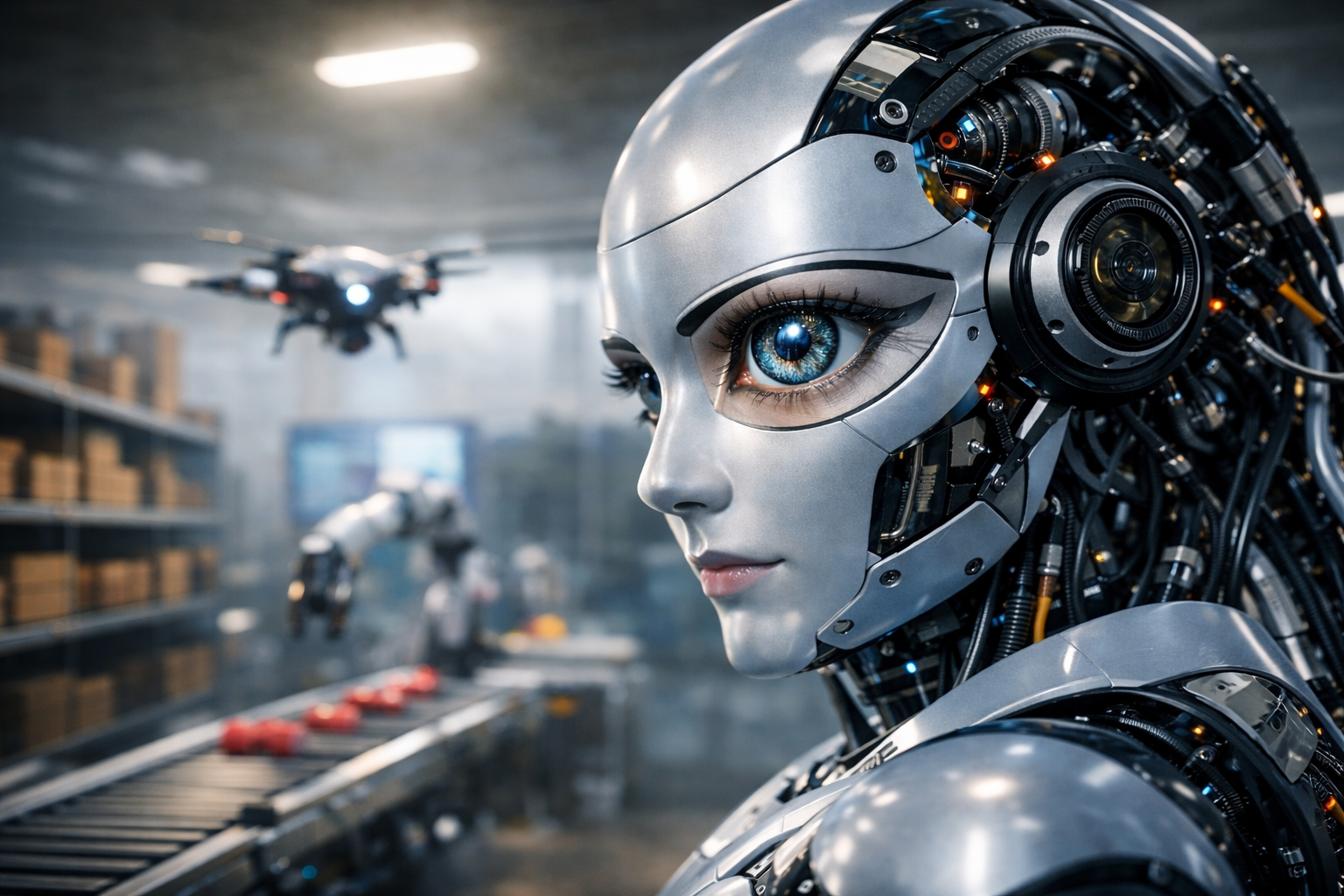
Researchers are making major strides in robotic vision by borrowing ideas from one of nature’s most advanced designs: the human eye. A new generation of robots equipped with human-inspired eyes is showing significantly improved visual performance, offering a promising path toward machines that can better understand and interact with the world around them.
For years, robotic vision systems have relied heavily on conventional cameras and sensors to detect objects, judge distance, and navigate through different environments. While these technologies have become increasingly sophisticated, they still face limitations in situations involving changing light, fast motion, or cluttered surroundings. Human eyes, by contrast, handle these conditions remarkably well, allowing people to quickly focus, track movement, and distinguish important details even in complex scenes.
Now, engineers and scientists are applying these biological principles to robotics. By designing visual systems that mimic the structure and function of human eyes, researchers have created robots that can process visual information more effectively. These human-inspired eyes do not simply copy the appearance of real eyes. Instead, they reproduce key features such as dynamic focusing, coordinated movement, depth perception, and efficient handling of visual input.
The result is a noticeable improvement in how robots see and respond. In tests, robots with these advanced eye-like systems have demonstrated better object recognition, improved tracking of moving targets, and more accurate navigation. This gives them an advantage in tasks where traditional robotic cameras may struggle, especially in unpredictable or rapidly changing environments.
One of the most important aspects of the human eye is its ability to focus quickly on objects at different distances. People shift attention almost instantly, whether looking at something nearby or far away. Robotic systems inspired by this feature can adjust more smoothly and rapidly, reducing blur and improving image clarity. This is especially useful in settings such as warehouses, hospitals, and public spaces, where robots may need to interact with objects and people at varying distances.
Another benefit comes from eye movement. Human eyes are constantly making tiny adjustments to gather useful visual information. These movements help the brain build a more complete and stable understanding of the surroundings. By integrating similar movement patterns into robotic vision, developers have enabled machines to scan environments more naturally and efficiently. Instead of relying on fixed views, robots can actively search for the most relevant details, improving both speed and accuracy in decision-making.
Depth perception is another area where human-inspired design is making a difference. Humans use two forward-facing eyes to judge distance and spatial relationships. This binocular vision allows people to catch a ball, drive a car, or walk through a crowded room without colliding with obstacles. In robotics, adding this type of coordinated visual processing helps machines perform delicate and precise tasks. A robot arm, for example, can more accurately grasp a fragile object, while a mobile robot can better move through narrow spaces.
Researchers say these advances could reshape several industries. In manufacturing, robots with better vision could identify defects on assembly lines more accurately and adapt to unexpected changes in product placement. In healthcare, surgical robots or assistive devices could benefit from more precise visual feedback, improving safety and performance. In transportation, autonomous systems could use enhanced vision to detect hazards more reliably and respond more effectively to real-world conditions.
The technology could also improve service robots designed for homes, offices, and care facilities. One of the biggest challenges for such robots is operating in environments built for humans, not machines. A robot in a home may need to recognize furniture, avoid pets, locate household items, and respond to human gestures. Human-inspired eyes could help make these tasks more practical by giving robots a more flexible and adaptive way of seeing.
Experts believe that mimicking human vision is not just about better hardware, but also about smarter processing. The eye works closely with the brain, which filters, prioritizes, and interprets a huge amount of visual data in real time. Robotic vision systems are beginning to follow a similar approach by combining advanced sensors with artificial intelligence algorithms. This allows robots to focus on the most useful information rather than processing every detail equally. In turn, this reduces computational load and helps machines react faster.
Despite the progress, challenges remain. Human vision is the product of millions of years of evolution, and fully reproducing its complexity is no simple task. Researchers must balance performance, power consumption, cost, and durability when designing robotic eyes. Systems that work well in the laboratory may still require further refinement before they can be widely deployed in everyday settings.
There are also broader questions about how these improvements will affect the role of robots in society. As machines become better at seeing and interpreting human environments, they may take on more responsibilities in workplaces and public life. Supporters argue that this could improve efficiency, reduce risks in dangerous jobs, and expand access to services. Others caution that increased automation should be introduced carefully, with attention to safety, ethics, and the impact on employment.
Even so, the momentum behind bio-inspired robotics continues to grow. Scientists have long turned to nature for engineering solutions, drawing inspiration from birds for flight, fish for underwater movement, and insects for mobility. The human eye now appears to be one of the most valuable models for the next stage of machine perception. Its influence is helping bridge the gap between artificial systems and the flexible, responsive abilities found in living organisms.
What makes this development especially significant is that vision is central to so many robotic functions. A robot that sees better can navigate better, manipulate objects better, and collaborate with people more effectively. Improved vision does not just enhance one isolated feature; it strengthens the entire system. That is why the move toward human-inspired eyes could mark an important turning point in robotics research.
As laboratories and technology companies continue refining these systems, the benefits may soon extend beyond research prototypes and into real-world applications. From factories and hospitals to homes and city streets, robots with more human-like vision may become increasingly common. Their ability to perceive the world with greater clarity and adaptability could make them more useful, more trustworthy, and more capable than ever before.
In the years ahead, the idea of robots seeing the world through human-inspired eyes may shift from scientific innovation to everyday reality. And if current progress continues, that reality may arrive sooner than expected.