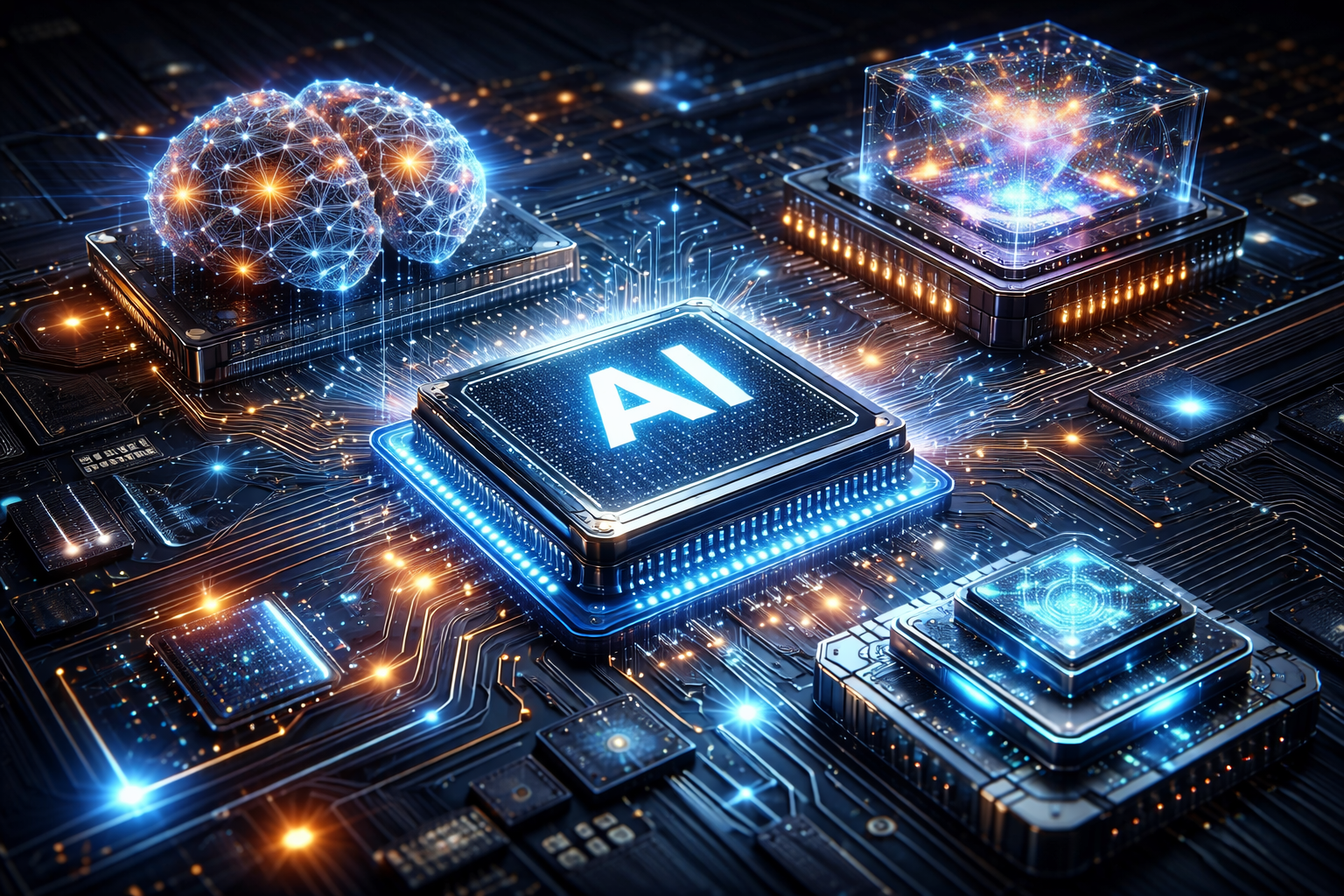
As artificial intelligence continues to evolve at a rapid pace, researchers are beginning to confront a growing challenge: today’s computer chips may not be enough to support the next wave of AI innovation. Experts now suggest that the future of artificial intelligence could depend on fundamentally different types of processors—designed specifically to handle the unique demands of increasingly complex systems.
For decades, advances in computing have been driven largely by improvements in traditional processors, particularly central processing units (CPUs) and graphics processing units (GPUs). These chips have powered everything from personal computers to large-scale data centers, enabling breakthroughs in machine learning, data analysis, and automation. However, as AI models become larger and more sophisticated, the limitations of these conventional architectures are becoming more apparent.
Modern AI systems, especially those based on deep learning, require enormous computational resources. Training large models can take weeks or even months, consuming vast amounts of electricity and requiring specialized hardware setups. Even running these models in real-time applications—such as voice assistants, autonomous vehicles, or advanced robotics—demands significant processing power and efficiency.
This growing demand is pushing researchers to rethink the very foundations of computing hardware. Instead of relying solely on general-purpose processors, engineers are exploring new chip designs tailored specifically for AI workloads. These include application-specific integrated circuits (ASICs), neuromorphic chips, and even quantum processors—each offering a different approach to handling complex computations.
One of the most promising developments is the rise of AI-specific chips. Unlike traditional processors, which are designed to perform a wide range of tasks, these chips are optimized for the mathematical operations that underpin machine learning. By focusing on tasks such as matrix multiplication and parallel processing, AI chips can deliver higher performance while using less energy. This makes them particularly valuable in large data centers, where efficiency and scalability are critical.
Neuromorphic computing represents another intriguing direction. Inspired by the structure and function of the human brain, neuromorphic chips aim to process information in a more efficient and adaptive way. Instead of performing calculations in a rigid, sequential manner, these systems use networks of artificial neurons that can learn and respond dynamically. This approach could lead to faster, more energy-efficient AI systems capable of handling tasks such as pattern recognition, sensory processing, and decision-making in real time.
Meanwhile, researchers are also exploring the potential of quantum computing for AI. Although still in its early stages, quantum technology promises to solve certain types of problems much faster than classical computers. In theory, quantum processors could accelerate complex optimization tasks and enable new forms of machine learning that are currently impractical. However, significant technical challenges remain before quantum AI becomes a reality.
The shift toward new types of processors is not just about performance—it is also about sustainability. The energy consumption of AI systems has become a growing concern, particularly as the scale of models continues to expand. Data centers already account for a significant portion of global electricity use, and AI workloads are contributing to that demand. By developing more efficient hardware, researchers hope to reduce the environmental impact of future AI systems.
At the same time, the move toward specialized processors raises important questions about accessibility and cost. Advanced AI chips can be expensive to design and manufacture, potentially concentrating power in the hands of a few large companies. This could create barriers for smaller organizations and researchers who may struggle to access the latest technology. Ensuring that innovation remains open and inclusive will be a key challenge as the industry evolves.
Another factor driving change is the increasing diversity of AI applications. From healthcare and finance to transportation and entertainment, AI is being used in a wide range of fields, each with its own unique requirements. A one-size-fits-all approach to hardware is no longer sufficient. Instead, the future may involve a mix of specialized processors, each tailored to specific tasks and environments.
Edge computing is a good example of this trend. As more devices—from smartphones to smart home systems—incorporate AI capabilities, there is a growing need for efficient, low-power processors that can operate locally rather than relying on cloud-based resources. Specialized chips designed for edge AI can process data quickly and securely, enabling real-time responses while reducing latency and bandwidth usage.
Industry leaders are already investing heavily in this new generation of hardware. Major technology companies are developing their own custom AI chips, while startups and research institutions are experimenting with novel architectures and materials. Governments are also recognizing the strategic importance of semiconductor innovation, leading to increased funding and policy support in many regions.
Despite the excitement, the transition to new processor technologies will not happen overnight. Existing infrastructure is deeply rooted in traditional computing architectures, and replacing or upgrading these systems will take time and significant investment. Compatibility, software development, and standardization are all challenges that must be addressed as new hardware becomes more widespread.
Nevertheless, the direction is clear. As AI continues to push the boundaries of what machines can do, the hardware that powers it must evolve as well. The next phase of artificial intelligence is likely to be shaped not just by advances in algorithms and data, but by breakthroughs in the processors that make those advances possible.
Experts believe that this shift could redefine the relationship between hardware and software. In the past, software innovation often adapted to existing hardware capabilities. In the future, hardware and software may be developed more closely together, with each influencing the design of the other. This co-evolution could unlock new levels of performance and efficiency, enabling AI systems that are faster, smarter, and more capable than ever before.
Ultimately, the move toward new types of processors reflects a broader transformation in computing. As technology becomes more specialized and complex, traditional approaches are giving way to more targeted solutions. While challenges remain, the potential benefits are significant—offering a path toward more powerful, efficient, and sustainable AI systems.
What once seemed like a distant possibility is now becoming an urgent priority. If current trends continue, the next generation of artificial intelligence may not just run on faster chips—but on entirely different kinds of processors designed for a new era of computing.