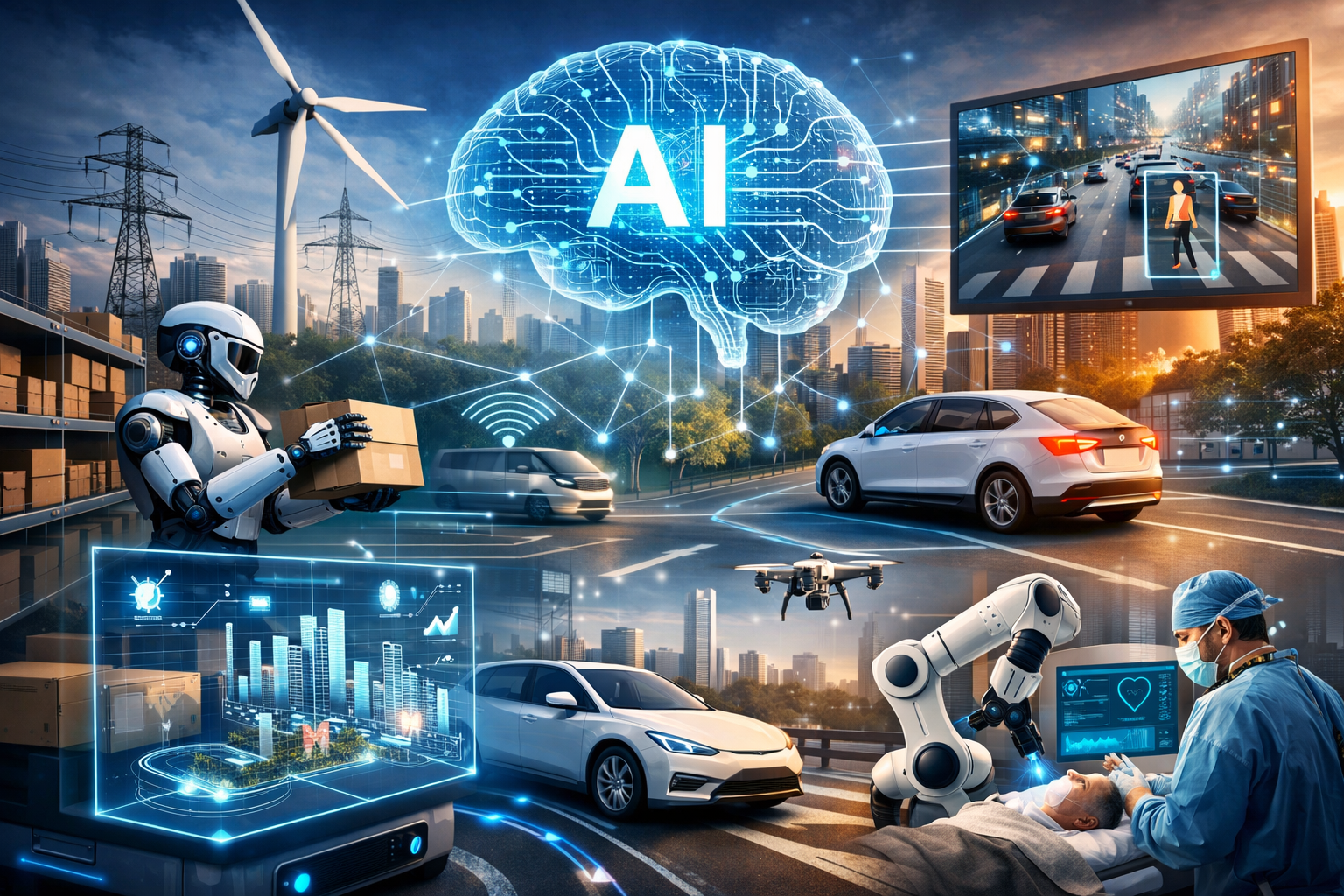
Artificial intelligence is entering a new phase of development as researchers and technology companies shift their focus from purely digital applications to tools designed for the physical world. For years, AI has powered recommendation systems, chatbots, and data analysis platforms operating behind screens. Now, the same underlying technologies are being adapted to interact directly with real-world environments—marking a significant step toward more tangible and impactful use cases. This transition is being driven by advances in computing power, sensor technology, and machine learning models that can process complex, real-time data from the physical environment.
A major area of progress lies in the integration of AI with robotics. Modern robots are no longer limited to repetitive, pre-programmed tasks; instead, they are becoming more flexible and adaptive. Equipped with computer vision, depth sensors, and advanced algorithms, these machines can identify objects, navigate dynamic spaces, and respond to unexpected changes. In warehouses, for example, AI-driven robots can sort packages, optimize inventory movement, and collaborate safely with human workers. In agriculture, autonomous machines are being developed to monitor crop health, apply fertilizers precisely, and even harvest produce with minimal human intervention.
Another important development is the use of AI in infrastructure and urban systems. Smart cities are increasingly relying on AI to manage traffic flow, reduce energy consumption, and improve public safety. By analyzing data from cameras, sensors, and connected devices, AI systems can adjust traffic signals in real time, detect anomalies, and predict maintenance needs before failures occur. Similarly, energy grids are becoming more intelligent, using AI to balance supply and demand, integrate renewable sources, and reduce waste. These applications demonstrate how AI can operate beyond virtual environments to directly influence the efficiency and sustainability of physical systems.
Healthcare is also experiencing a transformation as AI tools expand into physical settings. While AI has long been used for medical imaging analysis and diagnostics, new innovations are bringing it closer to patient care. Robotic-assisted surgery, AI-powered monitoring devices, and smart rehabilitation systems are enabling more precise treatments and personalized care. Wearable devices equipped with AI can track vital signs continuously, providing early warnings for potential health issues. In hospitals, AI systems can help manage workflows, optimize resource allocation, and reduce the burden on healthcare professionals.
Despite these promising advancements, deploying AI in the physical world introduces a new set of challenges. Unlike digital systems, physical environments are unpredictable and often involve higher risks. Ensuring the safety and reliability of AI systems is therefore a top priority. Engineers must account for edge cases, environmental variability, and potential system failures. For example, autonomous vehicles must be able to handle complex road conditions, unexpected obstacles, and human behavior—all in real time. Even minor errors in such contexts can have serious consequences, making rigorous testing and validation essential.
Ethical considerations also play a significant role in the development of AI for physical applications. Questions around accountability, transparency, and decision-making become more complex when AI systems interact directly with people and the environment. If an AI-powered robot makes a mistake, determining responsibility can be challenging. Additionally, concerns about job displacement, data privacy, and surveillance continue to grow as AI becomes more embedded in everyday life. Policymakers and industry leaders are working to establish guidelines and regulations that balance innovation with public trust and safety.
Another key factor influencing the adoption of physical-world AI is infrastructure readiness. Deploying these systems often requires significant investment in hardware, connectivity, and maintenance. For example, smart city initiatives depend on widespread sensor networks and reliable data transmission systems. Similarly, advanced robotics require robust hardware capable of operating in diverse conditions. As a result, adoption rates may vary across regions, with more developed areas leading the way while others face barriers related to cost and technical expertise.
Looking ahead, the convergence of AI with other emerging technologies is expected to accelerate progress even further. Developments in edge computing allow AI models to run locally on devices, reducing latency and enabling faster decision-making in real-world scenarios. Advances in materials science and hardware design are also making robots more efficient, durable, and capable of performing complex tasks. At the same time, improvements in machine learning techniques are enhancing the ability of AI systems to learn from limited data and adapt to new situations.
Ultimately, the preparation of AI tools for the physical world represents a fundamental shift in how technology interacts with society. Rather than remaining confined to screens and servers, AI is becoming an active participant in the environments we live and work in. This evolution has the potential to unlock new levels of productivity, safety, and innovation across multiple industries. However, it also requires careful planning, collaboration, and oversight to ensure that these technologies are developed responsibly.
As AI continues to move from theory to real-world application, its impact will become increasingly visible in everyday life. From the way goods are produced and delivered to how cities are managed and healthcare is provided, AI is set to play a central role in shaping the future of the physical world. The challenge for developers, policymakers, and society as a whole will be to harness this potential while addressing the risks and uncertainties that come with such a transformative shift.