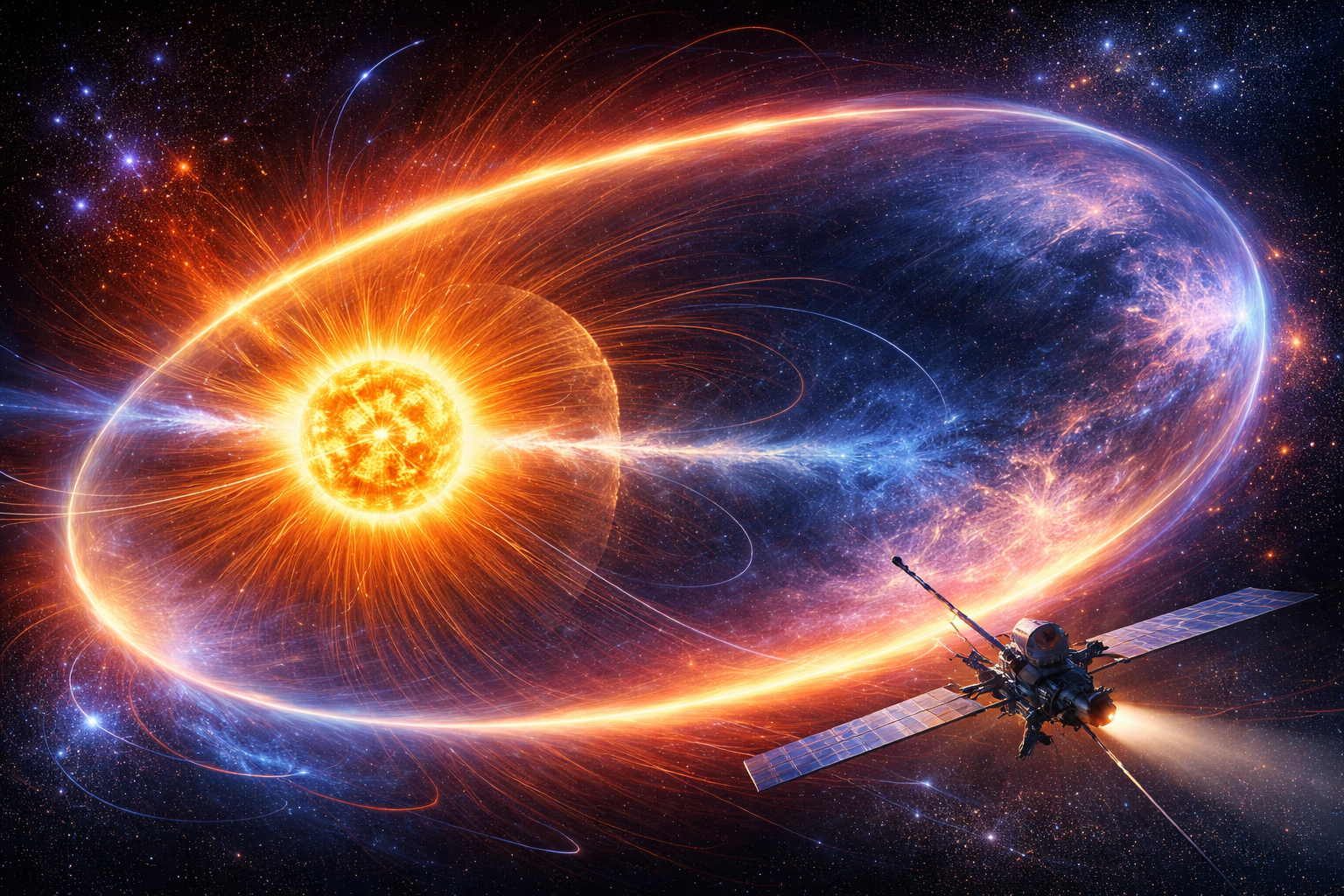
Scientists are preparing for a new space mission that could transform our understanding of one of the most important yet least understood regions surrounding our solar system: the heliosphere. Often described as a vast protective bubble created by the Sun, the heliosphere plays a crucial role in shielding Earth and other planets from harmful cosmic radiation. Despite its importance, many of its features remain poorly understood—something researchers hope to change with upcoming exploration efforts.
The heliosphere is formed by the solar wind, a continuous stream of charged particles released by the Sun. This flow expands outward in all directions, eventually encountering the interstellar medium—the matter that exists in the space between stars. Where these two forces meet, they create a boundary that defines the outer edge of the Sun’s influence. This enormous region extends far beyond the orbit of Pluto, encompassing the entire solar system.
Although scientists have studied the heliosphere for decades, its structure and behavior are far from simple. It is not a perfect sphere but rather a dynamic, constantly shifting region influenced by solar activity and external forces. Changes in the Sun’s output, such as solar flares and coronal mass ejections, can alter the shape and intensity of the heliosphere, affecting how it interacts with the surrounding galaxy.
One of the most intriguing parts of the heliosphere is its boundary, known as the heliopause. This is the point where the solar wind slows down and is balanced by the pressure of the interstellar medium. Beyond this boundary lies interstellar space, a region that has only been directly sampled by a handful of spacecraft, including NASA’s Voyager probes. These historic missions provided the first direct evidence of the heliosphere’s outer limits, but many questions remain unanswered.
The new mission aims to build on these discoveries by collecting more detailed data about the heliosphere’s structure and behavior. Equipped with advanced instruments, the spacecraft will study how particles and magnetic fields interact at the edges of the solar system. By doing so, scientists hope to gain a clearer picture of how the heliosphere forms, evolves, and protects the planets within it.
Understanding the heliosphere is not just a matter of scientific curiosity—it has practical implications as well. The heliosphere acts as a shield against high-energy cosmic rays, which originate from outside the solar system. These particles can pose risks to astronauts, satellites, and even technology on Earth. By studying how the heliosphere blocks or allows these particles to pass through, researchers can improve predictions of space weather and enhance protection for future space missions.
Another key objective of the mission is to explore how the heliosphere interacts with the interstellar environment. The solar system is not stationary; it moves through the galaxy, encountering different regions of interstellar space over time. These interactions can influence the size and shape of the heliosphere, potentially affecting the level of cosmic radiation that reaches Earth.
Scientists believe that studying these interactions could also provide insights into the broader processes that shape other star systems. The heliosphere is just one example of a stellar “bubble,” and similar structures likely exist around other stars. By understanding our own heliosphere, researchers can better interpret observations of distant systems and improve models of how stars interact with their surroundings.
The mission will also take advantage of technological advances that were not available during earlier explorations. Modern sensors can detect a wider range of particles and electromagnetic signals, allowing for more precise measurements. In addition, improved communication systems will enable the spacecraft to send back larger amounts of data over vast distances.
Despite these advancements, the mission faces significant challenges. The distances involved are enormous, meaning it could take years—or even decades—for the spacecraft to reach its target regions. Engineers must design systems that can operate reliably over long periods, often in harsh and unpredictable conditions. Power generation is another concern, as sunlight becomes weaker the farther the spacecraft travels from the Sun.
To address these challenges, mission planners are exploring innovative solutions, including more efficient propulsion systems and long-lasting power sources such as radioisotope generators. These technologies could not only support this mission but also pave the way for future deep-space exploration.
The timing of the mission is also important. The Sun follows an approximately 11-year cycle of activity, with periods of higher and lower intensity. Launching the spacecraft during a specific phase of this cycle could provide valuable data about how the heliosphere changes over time. By observing these variations, scientists can develop more accurate models of solar and interstellar interactions.
International collaboration is expected to play a key role in the mission’s success. Space agencies and research institutions from multiple countries are contributing expertise, technology, and funding. This cooperative approach reflects the global significance of the research, as understanding the heliosphere benefits not just one nation but the entire scientific community.
Public interest in the mission is also growing, driven by a broader fascination with space exploration and the mysteries of the universe. The idea of exploring the boundary between our solar system and interstellar space captures the imagination, offering a glimpse into a region that remains largely unknown.
Experts say that the findings from this mission could have far-reaching implications. In addition to improving our understanding of the heliosphere, the data could inform studies of cosmic radiation, star formation, and the evolution of galaxies. It may also help answer fundamental questions about how our solar system fits into the larger cosmic environment.
As preparations continue, scientists remain optimistic about what the mission could achieve. While the heliosphere may be vast and complex, each new piece of data brings us closer to understanding its role in shaping the conditions of our cosmic neighborhood.
In the coming years, as the spacecraft journeys toward the edge of the solar system, it will carry with it the hopes of researchers seeking to unlock one of space’s enduring mysteries. If successful, the mission could transform our view of the heliosphere—from a distant, abstract concept into a well-understood and vital component of our place in the universe.
If you found this article (สล็อต) engaging, feel free to explore more content or check out similar websites for related reads.