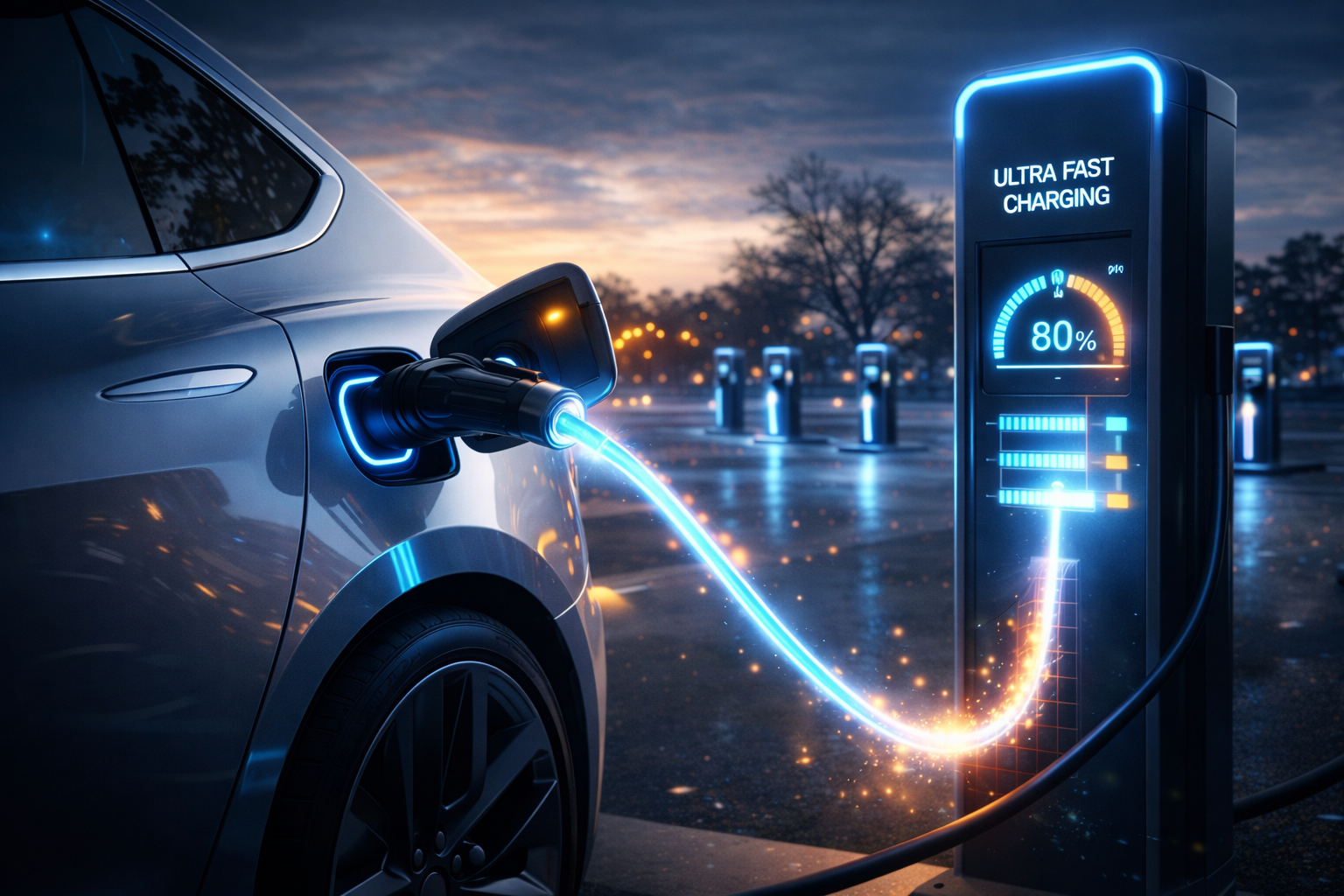
A new generation of electric vehicle (EV) batteries capable of charging in a fraction of the current time is rapidly moving from research labs to real-world applications. As automakers and technology companies race to solve one of the biggest barriers to EV adoption—long charging times—recent breakthroughs suggest that ultra-fast charging could soon become a standard feature rather than a distant goal.
Electric vehicles have gained significant momentum in recent years, driven by environmental concerns, government policies, and improvements in battery technology. However, one persistent challenge has remained: charging speed. While refueling a gasoline car takes only a few minutes, charging an EV can take anywhere from 20 minutes at a fast charger to several hours using standard home systems. This gap has been a key concern for consumers, particularly those worried about long-distance travel and convenience.
Now, researchers and manufacturers are making progress toward dramatically reducing charging times. New battery designs, materials, and charging systems are enabling EVs to recharge in as little as 10 to 15 minutes—approaching the experience of traditional refueling.
At the heart of these advances is a shift in battery chemistry and structure. Traditional lithium-ion batteries, while reliable, have limitations when it comes to rapid charging. Charging too quickly can lead to overheating, reduced battery life, and safety risks. To address these issues, scientists are developing new materials that can handle higher charging speeds without degrading performance.
One promising approach involves improving the anode, the part of the battery that stores lithium ions during charging. By using materials such as silicon or specially engineered carbon structures, researchers can increase the speed at which ions move in and out of the battery. This allows for faster charging while maintaining stability.
Another area of innovation is solid-state batteries. Unlike conventional batteries that use liquid electrolytes, solid-state designs replace them with solid materials. This change can improve safety, increase energy density, and potentially enable faster charging. Although solid-state batteries are still in development, many experts believe they could play a major role in the future of electric vehicles.
Charging infrastructure is also evolving alongside battery technology. Ultra-fast charging stations are being deployed in more locations, capable of delivering significantly higher power levels than earlier systems. These stations, often referred to as high-power or ultra-rapid chargers, can provide hundreds of kilometers of range in a short time, making long trips more practical for EV drivers.
Automakers are working closely with energy companies and governments to expand these networks. In many regions, public and private investment is accelerating the rollout of charging stations along highways, in cities, and at key travel hubs. The goal is to create a seamless charging experience that rivals the convenience of traditional fuel stations.
Despite the excitement, challenges remain. Rapid charging can place additional stress on batteries, potentially affecting their lifespan if not managed properly. Engineers are addressing this by developing advanced battery management systems that monitor temperature, voltage, and charging rates in real time. These systems help optimize performance and protect the battery from damage.
Cost is another factor. New battery technologies and high-power charging infrastructure can be expensive to develop and deploy. However, as production scales up and technology matures, prices are expected to decrease. This could make fast-charging EVs more accessible to a wider range of consumers.
There are also implications for the electrical grid. High-power charging stations require significant energy, especially if multiple vehicles are charging simultaneously. Utilities and grid operators are exploring ways to manage this demand, including smart charging systems, energy storage solutions, and integration with renewable energy sources.
For consumers, the benefits of faster charging are clear. Reduced charging times can make EVs more convenient for daily use and long-distance travel. Drivers may no longer need to plan trips around charging stops or worry about extended wait times. This could help accelerate the transition from internal combustion engines to electric mobility.
Industry analysts believe that faster charging could be a turning point for EV adoption. Surveys have consistently shown that charging time is one of the main concerns for potential buyers. By addressing this issue, manufacturers can make electric vehicles more appealing to a broader audience.
At the same time, experts caution that charging speed is only one part of the equation. Factors such as vehicle range, battery durability, cost, and infrastructure availability all play a role in shaping the EV market. A balanced approach that improves all these aspects will be essential for long-term success.
Environmental considerations also remain important. While EVs produce no tailpipe emissions, the overall impact depends on how electricity is generated and how batteries are manufactured and recycled. Advances in battery technology, including faster charging, must be accompanied by efforts to ensure sustainability throughout the entire lifecycle.
Looking ahead, the next few years are expected to bring significant developments. Several automakers have announced plans to introduce vehicles with faster-charging capabilities, while research institutions continue to push the boundaries of battery science. Pilot projects and early commercial deployments will provide valuable insights into how these technologies perform in real-world conditions.
In addition, competition within the industry is driving innovation. Companies are seeking to differentiate themselves by offering shorter charging times, longer ranges, and improved performance. This competitive pressure is likely to accelerate progress and bring new solutions to market more quickly.
The transition to faster-charging batteries could also influence other sectors beyond passenger vehicles. Electric buses, trucks, and delivery vehicles could benefit from reduced downtime, improving efficiency and reducing operational costs. This could further support the electrification of transportation on a larger scale.
Ultimately, the move toward rapid-charging EV batteries reflects a broader trend in technological advancement. As innovation continues, barriers that once seemed difficult to overcome are gradually being addressed. What was once considered a major limitation of electric vehicles may soon become one of their strengths.
While there is still work to be done, the direction is clear. Faster, more efficient charging is on the horizon, and it has the potential to reshape how people think about electric vehicles. If current progress continues, waiting hours to recharge may soon be a thing of the past—replaced by quick, convenient charging that fits seamlessly into everyday life.